


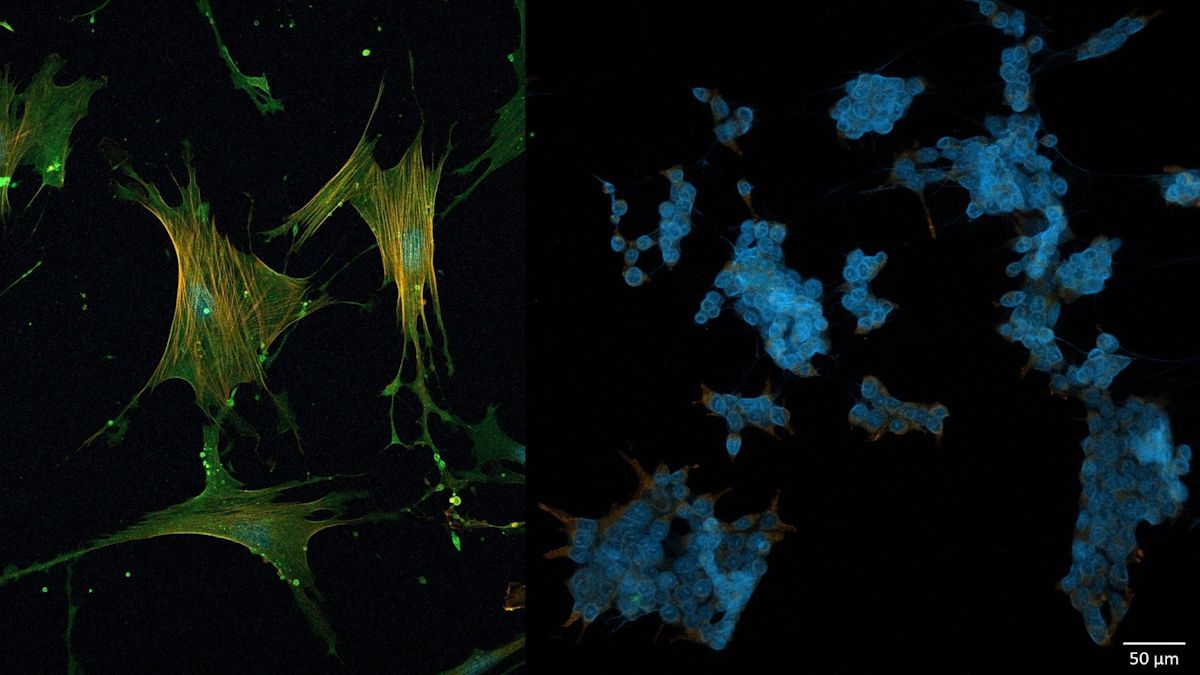
Pancreatic cancer is one of the most aggressive and difficult-to-treat cancers. One reason for its resistance to therapy is the dense tissue surrounding the tumour, which acts as a protective barrier and suppresses the immune response.
Researchers at Germany’s Karlsruhe Institute of Technology (KIT) have now identified a molecular mechanism that regulates this tumour-supporting environment. At the heart of this mechanism is CD44, a molecule that controls the behaviour of cancer-associated fibroblasts, specialised connective tissue cells that play a crucial role in shaping the tumour microenvironment. The results were published in Cell Death & Disease.
Tumours do not only consist of cancerous cells. They are surrounded by a complex tissue made of supporting cells, blood vessels, and immune cells – the tumour microenvironment. In pancreatic cancer, this surrounding tissue accounts for up to 90% of the tumour mass. Of particular importance are cancer-associated fibroblasts (CAFs), mutated connective tissue cells surrounding the tumour. They stimulate its growth and spread by growing a scar-like tissue structure and suppressing the body’s own immune response. As a result, many immunotherapies that help with other forms of cancer are often ineffective.
In their study, the researchers focused on the role of the CD44 molecule in cancer-associated fibroblasts. They demonstrated that CD44 intensifies important signals that activates these cells. In the laboratory, they inactivated CD44 in the mouse model as well as in human cells.
“This changed the fibroblasts dramatically. They produced less extracellular matrix, released fewer cytokines, and lost their ability to suppress the immune system. As a result, immune cells could attack the tumour cells more successfully, which significantly decreased the tumour size in a mouse model,” said Véronique Orian-Rousseau, head of the Cancer Cell Plasticity, Tumor Microenviroment and Metastasis research group at KIT’s Institute of Biological and Chemical Systems – Functional Molecular Systems (IBCS-FMS).
“The fact that we can change fibroblasts in a targeted manner by inactivating CD44 instead of destroying them opens up new prospects for more effective and less disruptive cancer treatments.”
The study ties in with a therapy approach against CD44 already pursued at KIT. Earlier work showed blocking certain CD44 variants on cancer cells can slow down the progression of pancreatic cancer. Based on this finding, the researchers developed a peptide directed at CD44v6, which has already been tested in a clinical study.
The current results suggest that blocking CD44 in the supporting tissue of tumours could also be therapeutically promising. However, further research will be needed to develop a clinical application.
In addition to the KIT scientists, researchers from TRON at the University Medical Center of Johannes Gutenberg University Mainz and researchers from the University of Freiburg took part in the study.