


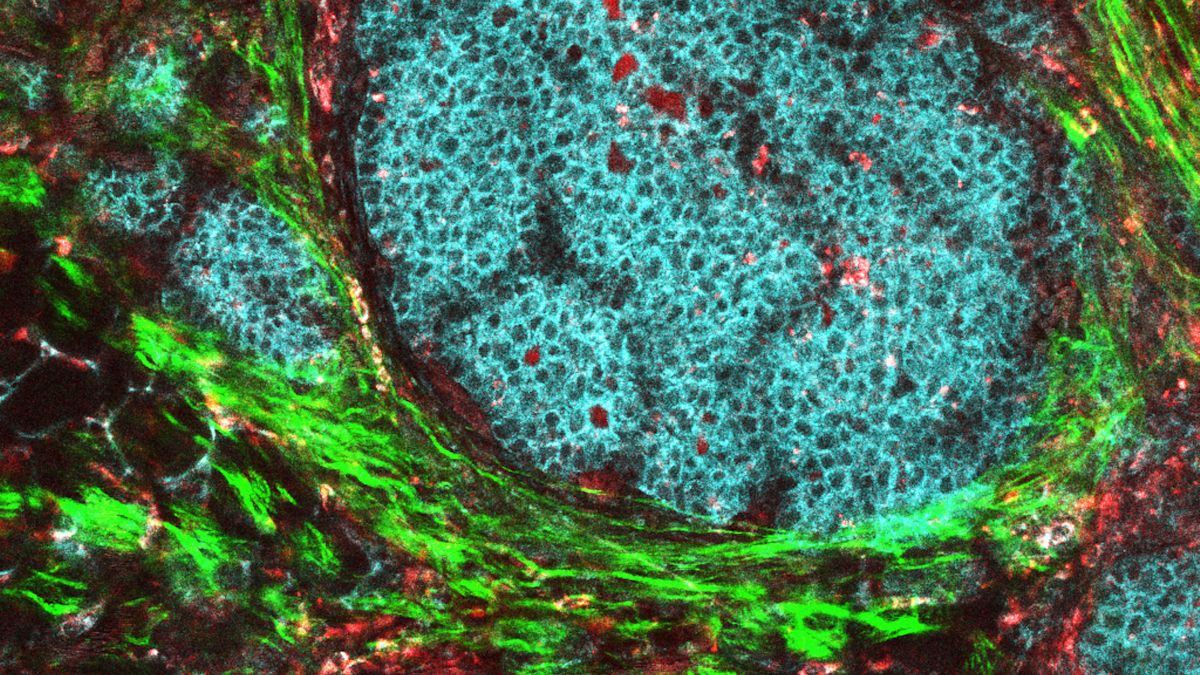
A research team led by Yoosoo Yang of the Department of Integrative Biotechnology at Sungkyunkwan University (SKKU), in collaboration with a research team led by Man Kyu Shim of the Korea Institute of Science and Technology (KIST), has developed an anticancer treatment platform that simultaneously targets cancer cells and the surrounding cells that support them, while blocking communication between the two.
Tumours do not grow through the activity of cancer cells alone. Cancer-associated fibroblasts (CAFs) and various immune cells gather around cancer cells, forming a complex community known as the tumour microenvironment. These cells communicate by exchanging extracellular vesicles (EVs), tiny packages that carry biological signals between cells. Through this communication, cancer cells become more aggressive, while surrounding cells help them spread to other organs and resist anticancer treatments. Conventional cancer therapies have primarily focused on directly attacking cancer cells, making it difficult to completely break this vicious cycle of support from surrounding cells.
To address this, the research team focused on epidermal growth factor receptor (EGFR), a cell-surface receptor expressed on cancer cells and upregulated in activated CAFs. By targeting EGFR, the researchers developed a degrader-antibody conjugate (DAC) that combines an antibody capable of precisely targeting these cells with a drug that selectively degrades cyclooxygenase-2 (COX-2) inside the cells. Once this precision-targeted agent enters the two cell types, it suppresses the production and secretion of extracellular vesicles that carry signals between them.
As a result, the communication network through which cancer cells and surrounding stromal cells reinforce one another is disrupted. In cell-based experiments, the treatment reduced CAF activation, cancer cell migration, and tumour-promoting macrophage polarisation. In an animal tumour model, it markedly suppressed tumour growth and remodelled the tumour microenvironment toward a more antitumor state. The study is particularly significant because it moves beyond conventional approaches that focus only on directly attacking cancer cells. By combining precision antibody targeting with targeted protein degradation, the new platform provides a strategy for disrupting the broader cellular ecosystem that supports tumour growth.
Yoosoo Yang said: “Cancer cells constantly communicate with surrounding cells to create an environment favourable to their own survival and growth. This study presents a new precision anticancer strategy that simultaneously targets cancer cells and their supporting cells while disrupting the harmful communication network between them, thereby affecting the tumour tissue as a whole.”
The findings were published in the Journal of the American Chemical Society (JACS).