


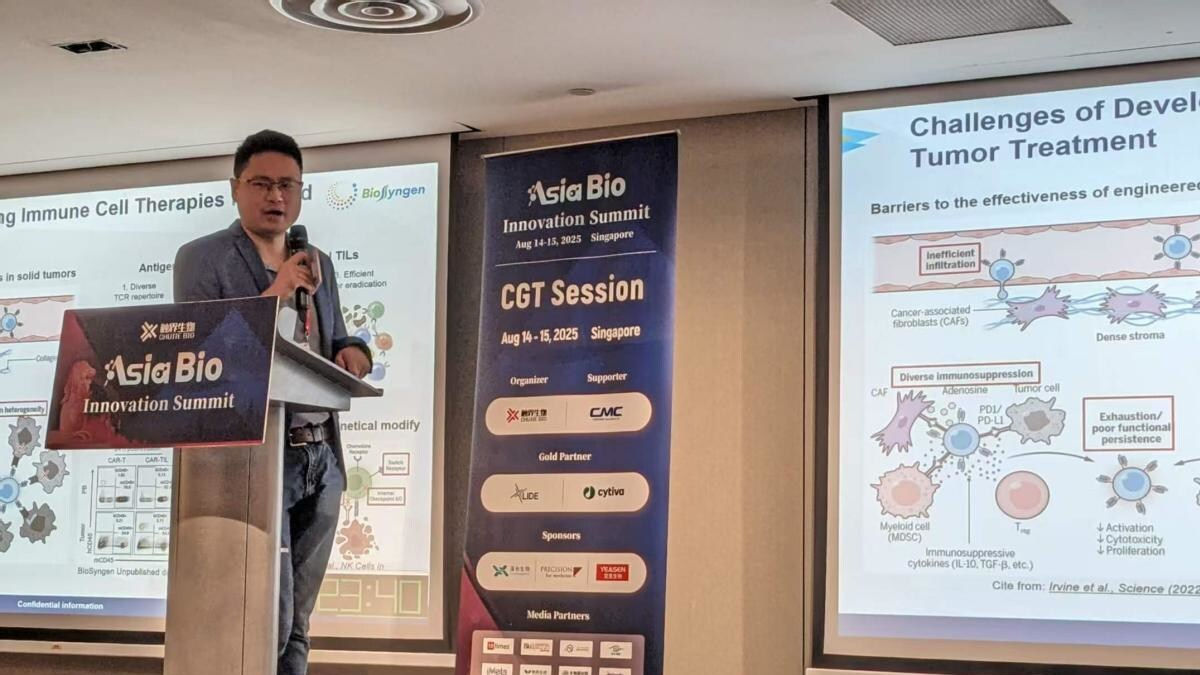
The Asia Bio Innovation summit 2025 Singapore spotlighted antibody-drug conjugates (ADCs) and cell and gene therapies (CGT), fostering in-depth discussions through keynote presentations and panel discussions to address critical challenges and solutions from bench to bedside.
Mingyu Liu, senior R&D scientist at Biosyngen, delivered a keynote titled “Next-Generation TIL Therapies: Challenges and Strategies,” outlining key bottlenecks and future directions in tumour-infiltrating lymphocyte (TIL) therapy development.
Liu emphasised that while TIL therapy has demonstrated unique potential in certain cancers — such as advanced melanoma and cervical cancer—its efficacy in other solid tumours remains to be further unlocked. He detailed Biosyngen’s strategic approach to overcoming these hurdles:
High-efficiency TIL expansion process – Enabling robust TIL expansion not only from surgical resection samples but also from biopsy samples, while preserving high antitumour activity. This addresses the challenge of obtaining surgical samples from late-stage cancer patients. Additionally, both primary tumour samples and final cell products can be cryopreserved, eliminating logistical constraints.
Enhancing memory T cell populations – Through proprietary rapid expansion protocols, Biosyngen has achieved an eight-fold increase in central memory T cells (TCM) within the final product while maintaining optimal CD8+ T cell ratios, which are critical for durable therapeutic effects.
Gene editing to augment TIL functionality – Utilising a lentiviral transfection system, Biosyngen ensures stable genetic modification of TILs, enhancing their persistence antitumour activity in vivo, with a transduction efficiency exceeding 50%.
Tumor antigen-specific T cell enrichment – By leveraging specific biomarkers or selective expansion techniques, Biosyngen enriches antigen-specific T cells, thereby improving clinical response rates.
A prevailing consensus is that ADC and CGT technologies will serve as key drivers of oncology innovation over the next decade. With its R&D landscape, vast market potential, and policy support, Asia is emerging as the new global powerhouse for biopharmaceutical breakthroughs.