


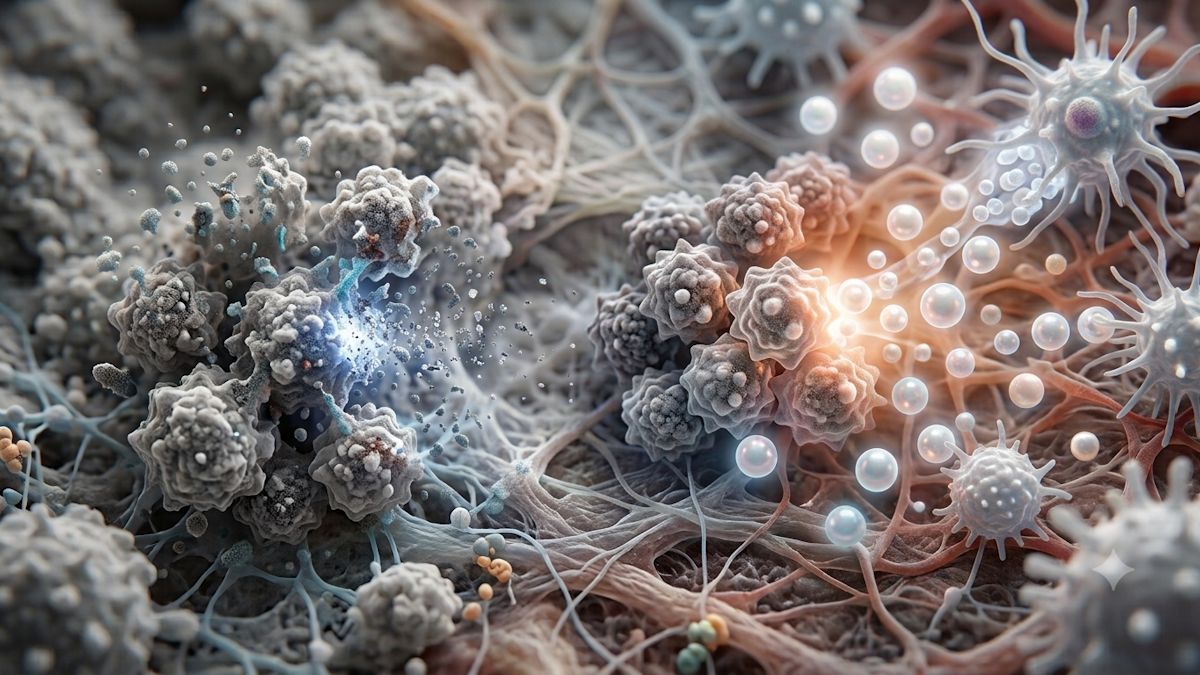
A research team led by Yoosoo Yang (Department of Integrative Biotechnology) at SKKU, in collaboration with the Korea Institute of Science and Technology (KIST) and Incheon National University, has successfully developed a next-generation anticancer immunotherapy technology that targets and eliminates key substances released by cancer cells while simultaneously boosting the patient’s immune response.
The research, carried out with support from the Ministry of Science and ICT’s Bio & Medical Technology Development Program (Next-Generation Bio), was published in Signal Transduction and Targeted Therapy.
Growing evidence in the field has shown that tumour-derived extracellular vesicles (TEVs)—nanoscale vesicles secreted by cancer cells—can not only promote tumour growth but, conversely, can also play a role in suppressing it.
*Extracellular vesicles are nanometre-sized vesicles secreted by cells that carry various biomolecules and mediate intercellular signalling. Tumour-derived extracellular vesicles are known to promote cancer growth, metastasis, and immune evasion.
However, existing pharmacological approaches have largely focused on non-selectively disrupting or suppressing the production of extracellular vesicles altogether. This approach has a critical limitation: it also blocks the function of “beneficial extracellular vesicles” capable of activating anticancer immune responses, thereby reducing overall treatment efficacy. A precision control technology was therefore needed—one that could selectively eliminate extracellular vesicles that promote cancer growth and metastasis, while selectively generating only those that activate anticancer immunity.
To address this challenge, the research team proposed a novel strategy called “Switching TEVs Off and On” and developed a nanoswitch-based therapeutic agent, “EVOTAC,” to implement it.
The therapeutic agent first targets and degrades key intracellular proteins to eliminate harmful, cancer-promoting extracellular vesicles and reset the tumour microenvironment (Switch-Off). A localised laser is then applied to the tumour site, reactivating the production of tumour-derived extracellular vesicles. At this stage, in response to photodynamic therapy, the tumour cells preferentially generate “immunogenic extracellular vesicles” that induce anticancer immunity (Switch-On).
*Photodynamic therapy is a treatment method in which a photosensitising agent is administered and then activated with a laser, generating reactive oxygen species that selectively destroy cancer cells and other diseased tissue.
When the team applied this nanoswitch strategy to animal models of triple-negative breast cancer and colorectal cancer, tumours were not only completely eliminated, but the activation of anticancer immune responses also effectively suppressed recurrence and metastasis.
This achievement reflects the intensive efforts of the joint research team, who, after extensive trial and error, succeeded in precisely controlling extracellular vesicles as both a therapeutic target and an immune-modulating factor.
By demonstrating that tumour-derived extracellular vesicles can serve simultaneously as a treatment target and an immune regulator, the study presents a new paradigm in cancer immunotherapy and is expected to spur follow-up research that opens new frontiers in the field.