


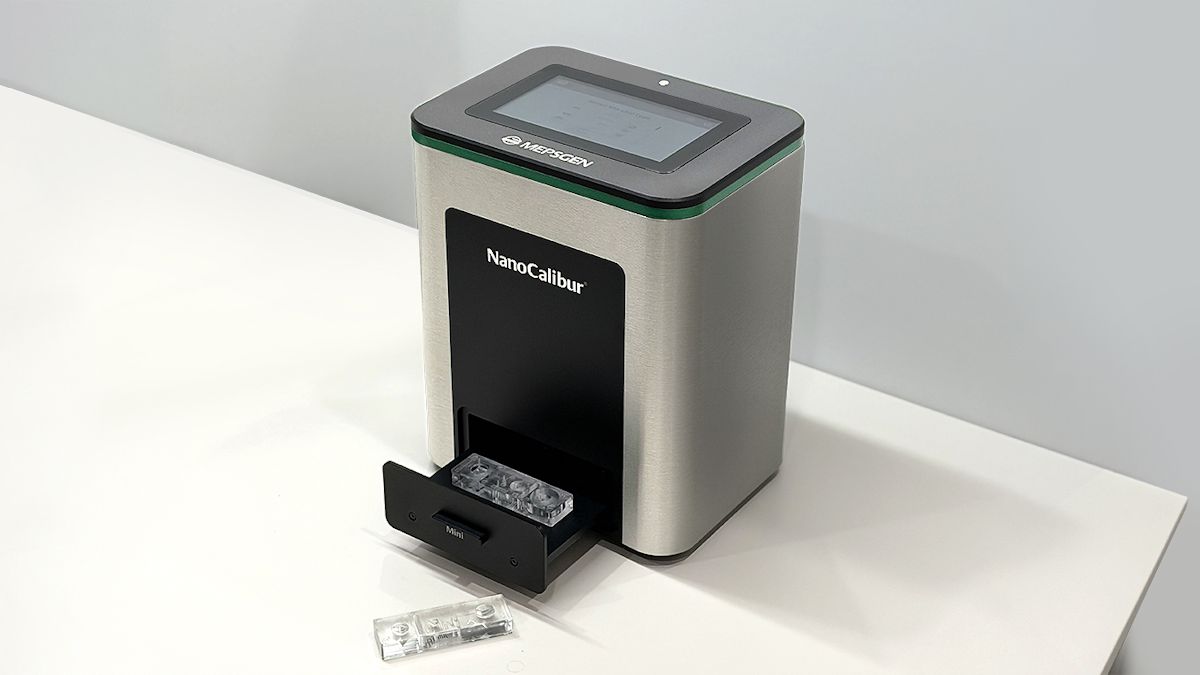
MEPSGEN US, Inc. has launched the NanoCalibur Mini, an automated system for small-volume nanoparticle formulation designed for early-stage drug discovery and development.
Nanoparticles are delivery vehicles that carry therapeutic payloads to target sites in the body, and they are central to next-generation modalities such as mRNA and gene therapies. Early-stage research requires repeated testing of many raw materials and process conditions, so the ability to generate fast, consistent results from limited material is essential.
NanoCalibur Mini formulates lipid nanoparticles (LNPs) and polymeric nanoparticles at volumes of 0.1–3 mL. Built on MEPSGEN’s microfluidic technology, it delivers microfluidic flow control for rapid and highly reproducible formulation. Researchers can choose between two single-use microfluidic cartridges, 0.1–0.4 mL and 0.4–3 mL, to match their application, from early formulation screening through a range of preclinical studies. The company said Mini helps accelerate development timelines while reducing reagent consumption and experimental costs.
With the addition of Mini, the NanoCalibur series now spans four systems (Mini, Lab, Pro, and GMP), allowing customers to select the right platform for their development stage and production scale.
The defining feature of the series is a consistent formulation environment at every scale. NanoCalibur Mini to Lab and to GMP uses the same microfluidic mixing pattern, with the same structure and dimensions. Rather than redesigning the mixer or changing the formulation conditions as production grows, NanoCalibur increases throughput by parallelising identical mixing units. This design is intended to reduce the need for process re-optimization during scale-up and technology transfer, while preserving nanoparticle quality and batch-to-batch reproducibility.
In large-scale nanoparticle manufacturing, the high flow rates required for throughput can generate shear forces that damage sensitive payloads such as mRNA and reduce potency. The NanoCalibur series is engineered to maintain stable shear conditions as production scales, helping preserve payload integrity and delivering consistent nanoparticle quality. Preserving payload potency can reduce the dose required for therapeutic effect, possibly addressing the high-dosage toxicity such as LNPs.
“With NanoCalibur Mini, we have extended our product lineup so that we can support customers more precisely at every stage, from early research through GMP manufacturing,” said YongTae Kim, CEO of MEPSGEN.
“We will continue to broaden the applications and customer base of the NanoCalibur Series and strengthen our position in the global nanomedicine manufacturing market.”